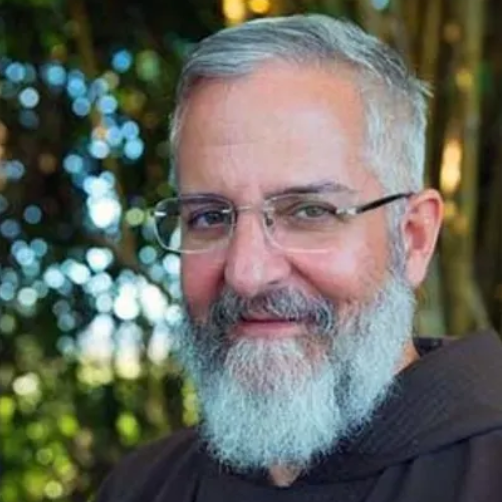
Thanksgiving Homily, Nov 27-2025
1st Reading: Sir 50:22-24
Psalm: Ps 138
2nd Reading: Col 3:12-17
Gospel: Mk 5:18-20
Homily from Our Director General, Fr. Joseph Tuscan
In 1789, George Washington declared a day of thanksgiving to acknowledge
“the providence of Almighty God, to obey his will, to be grateful for
his benefits, and humbly to implore his protection and favor.”
Washington set the day aside for Americans to give thanks for their
newly established government, but most of all, to render unto God
“sincere and humble thanks — for his kind care and protection.” In
his thanksgiving declaration, Washington rightfully acknowledged God as
“the beneficent Author of all the good that was, that is, or that will
be.”
Abraham Lincoln, America’s 16th president, said similar things in
proclaiming Thanksgiving Day a national holiday. It came during the
Civil War, Lincoln recognized God alone as the object of a nation’s
gratitude. He wrote that the day would be set aside to offer
“Thanksgiving and praise to our beneficent Father who dwells in the
heavens.”
“Thanks,” said G.K. Chesterton, “is the highest form of
thought.” He said that the worst moment for an atheist is when he is
thankful and suddenly realizes he has no one to thank.
The real origin of this national holiday has a Catholic history.
St. Augustine Florida was the site of the first Thanksgiving celebration
in America. In 1565, a fleet of Spanish ships bearing 800 colonists and
700 soldiers sighted land off the coast of Florida. Since it was Aug.
28, the feast of St. Augustine, the colony was named in honor of one of
our greatest doctors of the Church. The entire colony, all the settlers,
all the troops went ashore on Sept. 8. As he set foot on land, the
admiral of the fleet, Don Pedro Menendez de Aviles, kissed a crucifix
and then claimed the land for the king of Spain.
The colonists erected a makeshift outdoor altar and the colony’s
chaplain, Father Francisco López de Mendoza Grajales, celebrated Mass
— the first in Florida and the first in what is now the United States.
Members of the Timucuan tribe were drawn to the beach by the arrival of
the strangers and then stayed to watch the Mass. Afterward, the Spanish
invited the Timucuans to join them in a feast to thank Almighty God for
their safe arrival. And so Europeans and Native Americans shared a meal
together, in a spirit of gratitude for their blessings — and they did
so 56 years before the pilgrims and Wampanoag Indians celebration in
what is now Massachusetts.
We have all heard the story of the Pilgrims who came to Plymouth,
Massachusetts on a ship called the Mayflower. The story goes like this:
They were the first English settlers in America, they came for religious
freedom and they had a big feast with Indians, and that was the first
Thanksgiving. That is what Chesterton called; “The Myth of the
Mayflower.”
First of all, they were not known as “pilgrims” until about 200
years afterwards. They were Puritans, a radical Anglican “low
church” sect that loathed the “high church” Anglicans that
happened to include the King of England. In fact, about 30 years after
the Puritans arrived in America, some of their fellow Puritans back in
England arranged for King Charles I to have his head chopped off because
his wife and children were Catholic.
Secondly, there were at least nine other British settlements before the
Plymouth colony. All but one of them failed, including the first
settlement at Plymouth. The Puritans who came to Plymouth in 1620 almost
didn’t survive. Half the settlers died the first winter. They were
saved by a Native American named Squanto, who taught them how to hunt
and fish and grow corn.
Squanto was a Roman Catholic. In 1614, he had been captured by an
English party led by Captain John Smith (of Pocahontas fame) and taken
on a ship to Spain where he was to be sold as a slave. He was rescued by
some Dominican friars who instructed him in the Catholic faith. He told
them he wanted to return to his people in America. They helped him get
to England, where he met John Slaney, who taught him English and
arranged for him to get to Newfoundland. Squanto served as an
interpreter between the English and the Indians and crossed the Atlantic
six times. He was never able to return to his own tribe, because they
had been wiped out in a plague.
After he came to the aid of the Plymouth settlers, helping them grow
their own food, he arranged for a joint harvest feast with the local
Wampanoag tribe. So the classic story of Thanksgiving was started by a
Native American Catholic.
In 1621, the year after the Puritans arrived at Plymouth, another group
of English settlers arrived in Ferry, Newfoundland. The land had been
granted to George Calvert, the First Baron of Baltimore. Calvert’s
son, Cecilius, the Second Baron of Baltimore, was granted another chunk
of the New World, which he settled in 1632. He called it Maryland (named
for some woman whose name was Mary). England gave this land to George
Calvert and his son as compensation for being stripped of his title of
Secretary of State, why had he been stripped of his title? Because he
declared that he was a Roman Catholic. Maryland was the first English
Catholic settlement in the New World, and one of its founding principles
was freedom of religion.
The Puritans up the coast get all the credit for establishing freedom of
religion, but they did not, they were actually quite opposed to the
idea. They were anything but tolerant. In fact, it was their intolerance
that caused them to come to the new world, not persecution. England was
not Puritan enough for them. They did not think the Stuarts had gone far
enough to do away with the elements of Catholicism that still remained
in the Church of England. Puritan intolerance led to the eventual
execution of King Charles I. Puritan intolerance was further
demonstrated by a course of events in another Puritan settlement
established just six years after the one in Plymouth, just down the road
called Salem. It was there that anyone who departed from strict Puritan
practice was in danger of being labeled and burned as a witch.
Chesterton pointed out that the Puritans lost their belief in priests
but kept their belief in witches.
So Catholics deserve the credit not only for the first Thanksgiving, but
for the first real history of religious freedom in America, not the
Puritans whom we call Pilgrims. The puritans separated from the Anglican
church because they felt it was still too Catholic. This is perhaps why
G.K. Chesterton once said: “In America, they have a feast to celebrate
the arrival of the Pilgrims. Here in England, we should have a feast to
celebrate their departure.”
The very heart of Christian worship takes its name from the Greek word
expressing thanks. Eucharist means thanksgiving. It goes without saying,
then, that thanksgiving is a significant aspect of what the Mass is all
about. There is no real separation of church and state where the
celebration of Thanksgiving is considered. Citizens of the United States
have celebrated Thanksgiving, at least informally, since before the
country’s inception.
Both the Mass and the celebration of Thanksgiving Day call to mind the
very necessary reality that, as human beings, we are made to give
thanks.
The late archbishop of Chicago Cardinal Francis E. George, O.M.I., put
it best: “Recognizing that none of us is self-made and unwilling to
declare ourselves a cosmic accident, we turn to the Author of all that
is and say thanks. In the face of a gift that cannot be matched in
return, all one can do is be grateful.”
Our last words at Mass express our response: “Thanks be to God.”
Cardinal George explained their significance, saying that “Gratitude
to God shapes our lives, at their beginning and their end. Each moment
is a gift, each event unfolds under God’s loving providence.” The
challenge for Christians is to live each day in recognition that
everything is a gift, chief among which is our salvation. As St. Paul
exhorts us in the epistle for this Mass:
“And whatever you do, in word or in deed,
Do everything in the name of the Lord Jesus,
Giving thanks to God the Father through him.”