
Our History
The society found its way to America at an early date, and on the 16th of January, 1881, the Confraternity of Christian Mothers canonically erected in St. Augustine’s Church (now known as St. Pio of Pietrelcina Parish in Pittsburgh, PA), was raised to the rank of an Archconfraternity with the right of affiliating other Confraternities wherever the Ordinary approved.
Since then over 3,400 Confraternities have been affiliated with the Pittsburgh Archconfraternity directed by the Capuchin Friars.
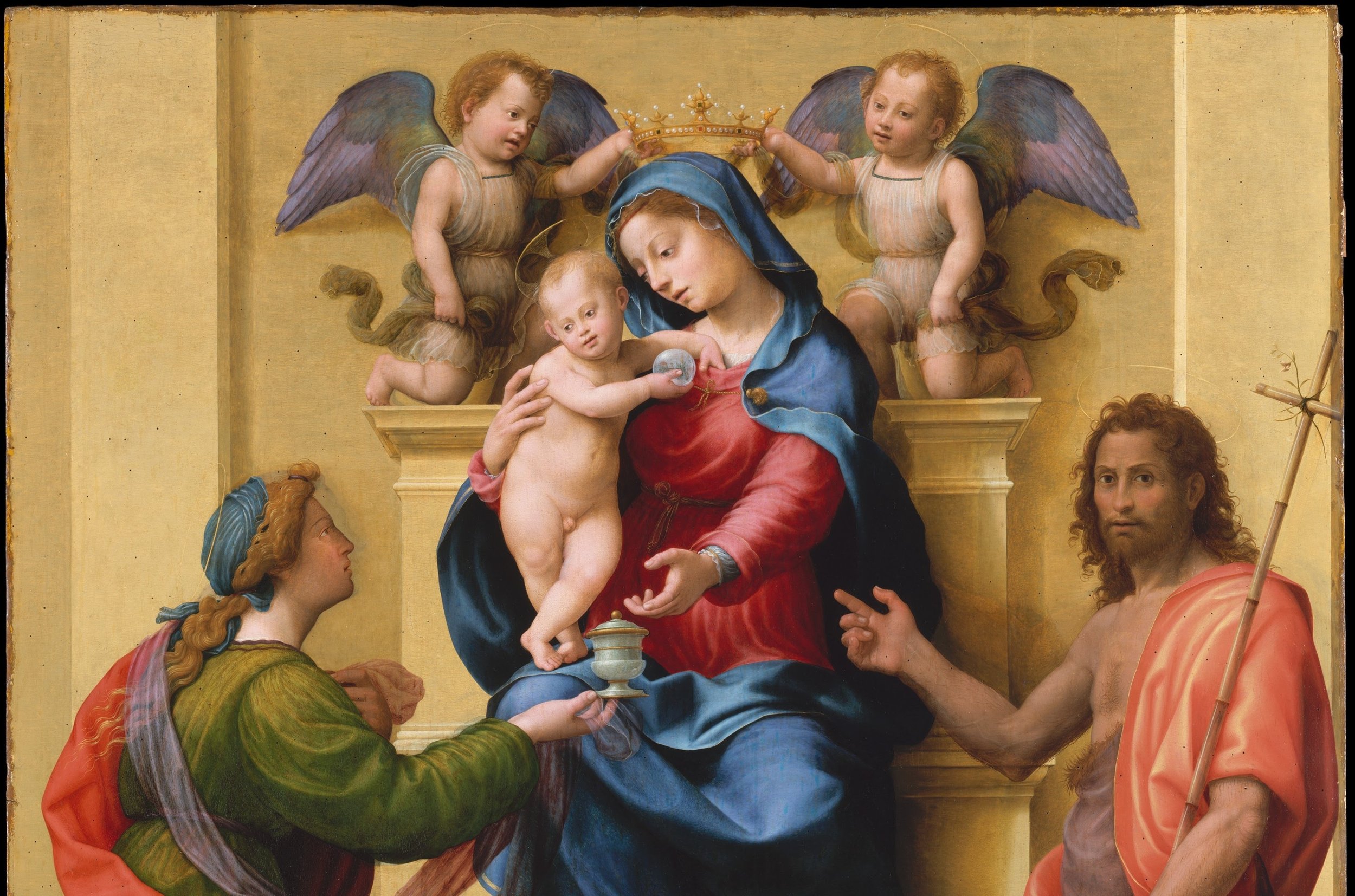
Our MissionWe serve as a pious association intended for mothers, which has for its special object the promotion of the good Christian and Catholic education of their children. The members join their hearts in love with the Immaculate Heart of the Blessed Virgin, the Mother of Sorrows, and unite under her patronage in mutual prayer and solicitude for the welfare of their children and families.
Document of Establishment
The 1886 Document of Establishment
This historic document, issued in 1886 under Pope Leo XIII, formally establishes the Archconfraternity of Christian Mothers in Pittsburgh and defines the authority entrusted to it for the growth and extension of the Confraternity.
We are making the original document and its translations available here particularly because questions have occasionally arisen concerning the authority of the Archconfraternity in Pittsburgh to support, encourage, affiliate, and establish Confraternities of Christian Mothers beyond the Diocese of Pittsburgh. The document itself provides the historical and canonical foundation for this mission and for the jurisdiction exercised by the Director General of the Archconfraternity in carrying it forward.
Rather than simply describing or asserting that authority, we believe it is helpful to make the foundational document itself readily available so that clergy, members, and others who may have questions can consult the source directly.
The original document is reproduced here together with translations in several languages for ease of reference. It remains an important witness not only to the history of the Archconfraternity, but also to the ecclesiastical foundation of its continuing mission to foster and extend the Confraternity of Christian Mothers wherever it may serve the spiritual good of Catholic mothers and their families.
A Deeper Dive Into Our History
-
Mothers needed to pray together, support one another, and help one another fulfill their responsibility for the Christian formation of their children. What began among mothers in France soon became an international spiritual movement that crossed languages, cultures, and continents.
The first organized conference of Christian Mothers was held in Lille, France, on May 1, 1850, under the leadership of Louise Josson de Bilhem. Mothers gathered to pray for one another and their children, to discuss the challenges of Christian family life, and to encourage one another in raising their children according to the Catholic faith. The movement quickly received ecclesiastical approval and spread throughout France and neighboring countries. Historical accounts indicate that eventually more than a million women were associated with the movement.
Paris: The First Great Archconfraternity
The movement soon established a major center at Notre-Dame de Sion in Paris. In 1856, the Association of Christian Mothers there was raised to the dignity of an Archconfraternity, with the privilege of aggregating other confraternities.
From Paris the movement spread rapidly throughout the Catholic world. Branches were established across continental Europe and eventually much farther abroad. France thus became the cradle of a movement that would unite generations of Catholic mothers in a common vocation of prayer, sacrifice, and Christian family life.
The historic Paris Archconfraternity is not presently known to function publicly under the same organizational structure that characterized it during the nineteenth and early twentieth centuries. Nevertheless, Paris occupies a foundational place in the history of the Christian Mothers because it became the first great international center of a movement that had begun among mothers in Lille.
Rome: A Center in the Heart of the Church
A Sodality of Christian Mothers was founded in 1863 at the Church of St. Augustine in Rome. In 1865 it was raised to the rank of a societas primaria and possessed a general faculty of aggregation. This gave the Christian Mothers another important center, now in the city of Rome itself.
The Roman foundation illustrates how rapidly the movement was expanding. Within little more than a decade of the first gathering in Lille, Christian Mothers had already become an international Catholic association with recognized ecclesiastical centers in both France and Rome.
Regensburg: Thousands of Confraternities
The movement also spread quickly into the German-speaking Catholic world. A Confraternity of Christian Mothers was established in Regensburg, Germany, in 1868, centered at the Church of St. Ägidien.
In 1871, the Regensburg association was elevated to the dignity of an Archconfraternity. It subsequently received the right to incorporate other Confraternities of Christian Mothers throughout the German-speaking world. Its formal title emphasized the patronage and intercession of the Sorrowful Virgin Mary.
Regensburg became one of the most important centers of the Christian Mothers movement anywhere in the world. Its surviving historical register contains records of more than 7,000 associations from 72 dioceses. This extraordinary number reveals the enormous influence of the movement among generations of Catholic families throughout Germany and neighboring regions.
During the twentieth century, many local Christian Mothers associations in Germany gradually became part of broader Catholic women’s organizations. As a result, the historic Regensburg Archconfraternity no longer functions publicly as the enormous aggregating organization it once was. Its spiritual and historical influence, however, remains an important part of the development of organized Catholic women’s life in the German-speaking Church.
Kraków and Einsiedeln
Other important Archconfraternities were subsequently established in Kraków, Poland, and Einsiedeln, Switzerland.
The Kraków Archconfraternity was associated with the Church of St. Barbara and dates from 1913, while an Archconfraternity was established at the famous Benedictine Abbey of Einsiedeln in Switzerland in 1944. These foundations brought the same spirituality of Christian motherhood into additional parts of Catholic Europe.
The upheavals of the twentieth century—including two world wars, political persecution, enormous social changes, and the reorganization of Catholic lay associations—greatly altered the institutional world in which many European confraternities had flourished. The historic European Archconfraternities are not presently known to operate publicly with the same widespread affiliating structures that characterized them in earlier generations.
-
The Christian Mothers movement reached the United States during the nineteenth century and became particularly strong among Catholic immigrant communities.
A Confraternity of Christian Mothers was established at St. Augustine Church in Pittsburgh, Pennsylvania, and on January 16, 1881, it was raised to the dignity of an Archconfraternity, with the right to affiliate other local Confraternities with the approval of the local bishop. Pittsburgh subsequently became the principal Archconfraternity for the movement in North America.
The Pittsburgh Archconfraternity became closely associated with the Capuchin Franciscan Friars, who have cared for and promoted the Confraternity for generations. More than 3,400 local Confraternities have been affiliated with Pittsburgh during its history.
Unlike many of the historic European centers, the Pittsburgh Archconfraternity continues its mission today, assisting in the establishment and renewal of local Confraternities and promoting the original purpose of the movement: the sanctification of mothers and families through prayer, the Sacraments, Christian formation, mutual support, and devotion to Our Lady of Sorrows.
-
The history of the Christian Mothers did not end in Europe and North America. The movement also took deep root in Africa, where Catholic mothers made the Confraternity their own and adapted its spiritual heritage to the life of the rapidly growing African Church.
Nigeria: More Than a Century of Christian Mothers
Nigeria possesses one of the strongest and most clearly documented Christian Mothers traditions in Africa.
The Confraternity of Christian Mothers was introduced into Nigeria in 1920 at Corpus Christi Parish in Bende, in what is today Abia State and the Diocese of Umuahia. Nigerian historical accounts identify a Capuchin priest, Rev. Fr. Murphy, as the missionary who introduced the Confraternity there.
From Bende, the Confraternity spread to neighboring communities and eventually throughout other parts of Nigeria. By the 1940s and 1950s, the Confraternity had become established in Lagos, including at St. Michael’s Catholic Church, Lafiaji, and Holy Cross Cathedral. In 1960 a Confraternity was established at the Church of the Assumption in Falomo.
Two important organizational developments followed. In 1984, the Lagos Archdiocesan Confraternity of Christian Mothers was formally organized as an archdiocesan coordinating body. In 1987, a national structure was established to coordinate the work of the Confraternity throughout Nigeria.
The Nigerian Confraternity celebrated its centenary in 2020, marking one hundred years since its establishment at Bende. Today the Confraternity continues to flourish throughout numerous dioceses, bringing Catholic mothers together through prayer, meetings, spiritual formation, charitable works, and the promotion of strong Catholic family life.
The Nigerian Confraternity consciously identifies itself with the same historical movement that began in Lille. It honors Our Lady of Sorrows as its patroness and continues the fundamental mission of the original Confraternity: the sanctification of mothers and their families.
The Nigerian story is especially significant because of the role of the Capuchin Franciscan tradition. The Confraternity was introduced at Bende by a Capuchin missionary, while the Pittsburgh Archconfraternity has likewise been entrusted historically to the Capuchin Friars. The flourishing Confraternity in Nigeria therefore represents not a modern imitation of the older European movement but a century-old African expression of the same spiritual tradition.
Ghana: A Longstanding Christian Mothers Movement
The Christian Mothers also became firmly established in Ghana, where the organization has often been known as the Christian Mothers Association.
Historical records concerning Catholic missionary development in Ghana identify the Christian Mothers among the Catholic lay organizations that took root and spread through the parishes. The movement experienced considerable growth and became an established part of Catholic life in a number of dioceses.
The Christian Mothers continue to be found among active Catholic parish societies in Ghana. Their presence represents another substantial African expression of organized Catholic motherhood, emphasizing prayer, Christian family life, mutual support, charitable service, and the responsibility of mothers for the religious formation of their children.
Although the available historical record does not provide the same detailed chronology that survives for Nigeria, the evidence clearly demonstrates that the Christian Mothers became an established and enduring part of Catholic parish life in Ghana.
Uganda and East Africa
The Confraternity of Christian Mothers is also present in Uganda, forming part of the strong tradition of Catholic lay associations that has characterized the Church in East Africa.
Ugandan Catholicism has developed a particularly strong tradition of lay participation, Marian devotion, family spirituality, and parish-based Catholic associations. The Christian Mothers movement shares this emphasis on prayer for children, Christian formation within the home, mutual support among mothers, and fidelity to Catholic family life.
The available historical record for the Confraternity in Uganda is less detailed than that of Nigeria. Nevertheless, the presence of groups using the name Confraternity of Christian Mothers demonstrates that the spirituality and identity of the movement have taken root there as well.
Together, Nigeria, Ghana, Uganda, and other African countries demonstrate that the Christian Mothers movement is not simply a European association belonging to the past. It has become part of the living Catholic heritage of Africa.
-
The history of the Confraternity of Christian Mothers now spans more than 175 years.
From the first mothers gathering in Lille in 1850, the movement spread to Paris, Rome, Regensburg, Kraków, Einsiedeln, Pittsburgh, and eventually across the missionary world. In Europe it united thousands of local associations. In North America it found a lasting home in Pittsburgh. In Africa it took root so deeply that in Nigeria alone the Confraternity has now flourished for more than a century.
The outward forms of the Confraternity have differed from country to country, but the essential mission has remained remarkably consistent: to help Catholic women recognize motherhood as a vocation to holiness, to assist them in the Christian formation of their children, and to unite mothers in prayer and mutual support.
Under the patronage of Our Lady of Sorrows, Christian Mothers have prayed across generations for their children, husbands, families, parishes, and the Church. They have recognized that the renewal of Christian society begins in the home and that the faith, prayer, sacrifice, and example of a mother can shape not only one child but generations yet to come.
The continuing life of the Confraternity in places such as the United States and Nigeria demonstrates the enduring relevance of the vision born in France in 1850. The circumstances confronting families have changed dramatically, but the need for holy mothers, strong Catholic homes, and communities of women committed to helping one another live their faith has not.
Today the Confraternity of Christian Mothers continues this international spiritual inheritance, joining the mothers of the present generation to those who have gone before them in a common mission: the sanctification of mothers and their families, the Christian education of children, and the renewal of the Church and society through holy family life.
Looking for more?
Learn more about the Confraternity of Christian Mothers in this interview with our National Father Director, Fr. Joseph Tuscan (O.F.M. Cap.) and our Lady National President, Colleen McDanald at EWTN on At Home With Jim & Joy. Here, Fr. Joseph and Colleen McDanald share the history, membership, and mission of the Archconfraternity of Christian Mothers and also explore a mother's role in the Church.